
 Most climate conscious entities don’t like fossil fuel lobbyists; Shocker, right? But what you may not know is countries who invest and receive money from oil-producing sites may actually be interested in doing business with big oil companies.
I had the opportunity to experience the love and hate Exxon Mobil receives by executing a Mock United Nations Meeting. And no, I was not assigned this role, I chose it. I took on the most obnoxious position in a CLIMATE conference since I am a business administration student concentrating in sustainability, so this role was perfectly ironic. By drawing up valid arguments in favor of fossil fuel industries I do the cost benefit analysis of economic growth versus environmental protection.
In preparation for all the heat I knew I was going to receive, I did my research. From looking at all the data there is no doubt that fossil fuels make up a big portion of the global carbon emissions, but the most effective angle I worked was to focus on all the benefits oil produces and introduce practical alternative methods to reduce greenhouse gases. In cahoots with Royal Dutch Shell, we promoted afforestation programs as a method of carbon capturing and advocated for lower developed countries to use whatever necessary resources to raise their standard of living. We enacted these strategies to ensure our security in future business ventures.
The goal of the conference was to reduce carbon emissions enough for the projected temperature to not surpass two degrees Celsius. Two was the golden number since it represents the threshold of our resilience. Beyond this degree numerous natural catastrophic events like intensified hurricanes and extreme droughts would occur, threatening the wellbeing of ecosystems, animals and people all over the world. As we went around the room to give our opening statements, countries and climate change activists made it clear I was the enemy there. I still, however, delivered my main points of afforestation and current dependency on nonrenewable resources.
Negotiations went far better than I imagined. As an oil company I do not have as much say as a country, but I still created a big impact as a global extractor and supplier of energy. I bargained with superpowers, climate activists and less developed countries. After a couple of back-and-forth’s I ended up making the following deals:
- A lumpsum payment of 1 billion dollars to Canada for oil sites.
- A donation of oil rigs in return for oil sites claimed by Russia and 1.7 billion dollars.
- A collaboration with climate change activists to place renewable energy resource technology on offshore platforms in exchange for publicity.
- A payment of 16 billion dollars to less developed countries if most of their energy is Exxon Mobil derived and allowance for the implementation of Exxon biofuel plants.
- Another payment to less developed countries for 7.5 billion dollars in return for 8 billion dollars from the United States and oil sites.
Although the numbers are not concrete, completing this mock negotiation made me understand why it is difficult for the United Nations to come to a full consensus.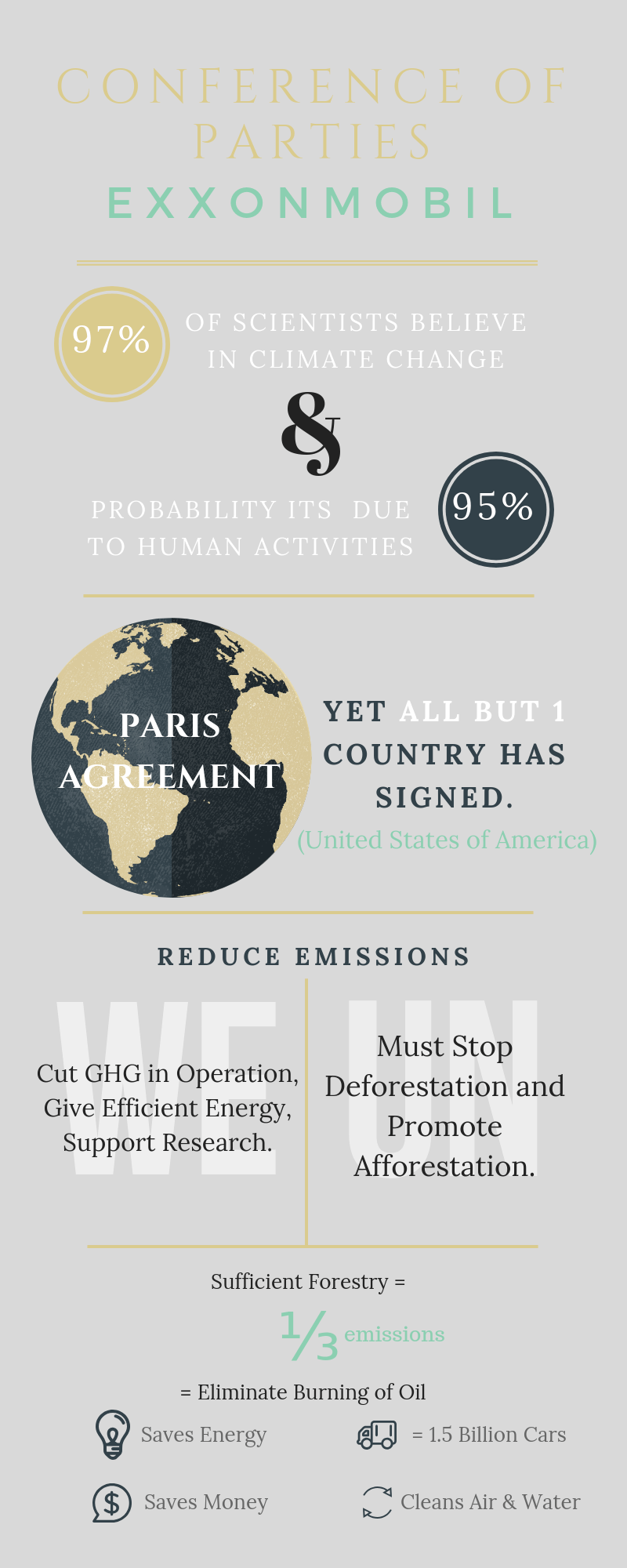

 The Underwater City Herald